Roller presses
Power meets
precision:
High-performance
roller presses
Roller Presses –
how we support you
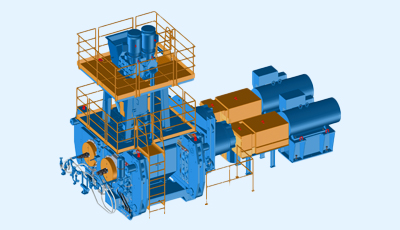
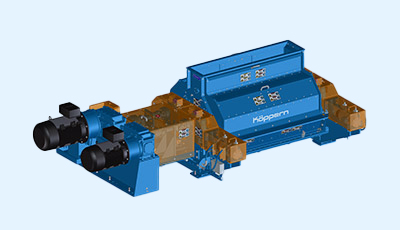
Köppern roller presses consist of two counter-rotating rollers that are mounted in a frame and supported by spherical roller bearings. In addition to radial loads, the bearings can also absorb axial loads, allowing the rollers to run at a certain angle to each other during operation. The fixed roller is supported directly in the press frame, while the so-called loose roller is supported against a hydro-pneumatic spring. The basic principle of the roll press is based on the loose roll. The distance between the rolls is determined by the ratio of the pressing force of the hydraulic system to the reaction forces exerted by the material to be processed and the preset "zero gap." The distance is controlled by the hydraulics according to the requirements of the respective process. This design principle ensures constant process conditions for the material in the roll gap, which guarantees uniform properties of the press discharge material.
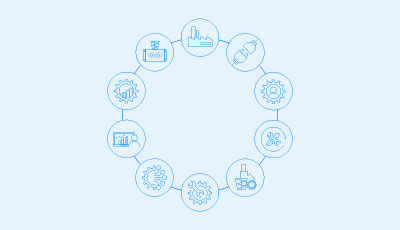
Our roller presses consist of several central assemblies:
- Robust press frame
- High-precision press rollers with bearings and bearing housings
- Powerful main drive with reduction gearbox
- Efficient material feed
- Reliable hydraulic system
- Easy-to-maintain lubrication
- Stable roller cover housing
Benefit from our modular machine concept, which offers you maximum flexibility and tailor-made solutions for your individual production requirements.
Important criteria when selecting the right roller press are the physical properties of the material to be processed, such as grain size distribution, density and moisture, as well as the desired product properties and target grain sizes.
Based on these application-specific requirements, we then design the roller press with the following properties.
- circumferential speed
- pressing force
- Briquette shape and size
- Design of pressing tools and feed systems
These factors are decisive in finding the machine that is best suited to you.
Hot briquetting
High-temperature solutions. Maximum load capacity.
Plants and machinery
for hot briquetting
The heart of every hot briquetting plant is a specially designed roller press, built to withstand the highest temperatures and pressure conditions.
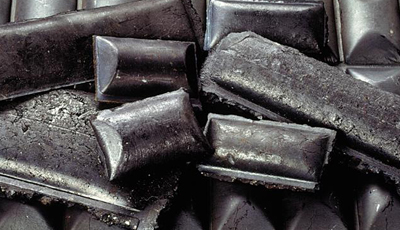
The hot iron sponge is fed directly from the reactor to the hot press. The HBI (hot briquetted iron) is forged at approx. 750°C and with a pressing force of up to 180 kN/cm. The resulting briquette strand is discharged via a chute, fed to the separator, and separated into briquettes.
Roller press
for hot briquetting:
Special technical features for high-temperature applications:
- Water cooling of heat-sensitive components
- Inert gas injection to minimize reoxidation
- High temperature resistant materials
- Design with tolerance for thermal expansion
Cold briquetting
Modular. Customizable. Efficient.
Plants and machinery
for cold briquetting
Our roller presses and systems feature a modular design for maximum flexibility in adapting to your specific requirements.
Whether small or large briquette formats: we supply briquetting tools in a wide range of dimensions, materials, and coatings—precisely tailored to your product, your processes, and your production goals.
We offer customized technical solutions depending on the application and material used. highly wear-resistant materials are used, which ensure a long service life and economical operation.
Roller press
for cold briquetting:
Key technical data at a glance:
- Pressing force: from 25 kN/cm (e.g. for metallurgical residues with binder) to 140 kN/cm (e.g. for aluminum)
Bearing size
Max. pressing force [kN]
40
1,430
52
2,330
60
2,910
72
4,970
92
7,350
500
8,700
630
12,950
- Scalability: The required pressing force increases proportionally with the roller diameter and the size of the briquette shape
- Solutions for a wide range of feed materials and process requirements
- Various briquette sizes available
Standard briquettes
Nominal
volume
5 cm3
10 cm3
20 cm3
60 cm3
L
30 mm
33 mm
43 mm
62.5 mm
B
24 mm
30 mm
34 mm
53 mm
H
17 mm
20 mm
25 mm
34 mm
Compaction
Turning bulk material into value.
Plants and machinery
for compaction
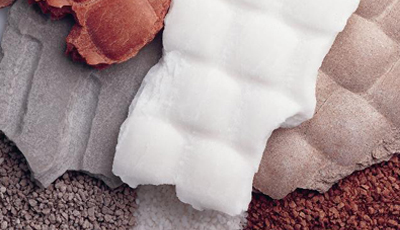
Our compacting presses are the core component in compacting granulation plants, which are used in the fertilizer industry, among others. They compress fine-grained solids – mainly salts – between two counter-rotating, profiled rollers to form a solid material strand, known as a flake. To do this, the material is fed into the roller gap via a screw feeder and compacted under high pressure. The flake is then broken down to the desired granulate size in the crushing/screening circuit.
Central assemblies
of the briquetting press:
Communication
Compact. Consistent. Cost-effective.
HPGR for comminution
The introduction of high-pressure grinding rolls (HPGR) in the 1980s represented a groundbreaking technological breakthrough, significantly reducing energy requirements while maintaining the same product fineness—especially for the cement and ore industries.
The new application placed the highest demands on wear protection.
Bearing size
Max. pressing force [kN]
52
2,000
60
2,510
72
3,710
84
4,840
92
5,530
500
6,590
560
8,010
630
9,710
710
11,620
750
13,270
900
16,410
950
18,310
1000
20,520
Central assemblies
of the HPGR:
Contact us
Contact us for your
customized solution
Would you like to learn more about our roller press expertise?
Our experts will be happy to advise you and work with you to develop a solution that is precisely tailored to your production requirements.